A Guide on Creating an Enjoyable Beer that Defines Your Style
 |
| "Image courtesy of VisitMontgomery.com" |
I didn’t care much for beer when I was younger. In fact, I
didn’t enjoy a “cold brew” until my late teen years when I tasted my first
craft beer. But what really peaked my interest in craft beer, a holy grail of
drinks, was the discovery of microbrews. Now, some people might say that
alcoholism and science cannot coexist. Home-brewing not only disproves this
idea, but it also shows how the two enhance one another to produce a beverage
of such quality enjoyment. Like any practice, the brewing process gets easier
and results in a better product with each subsequent trial. Now if you read
this guide and your first brew doesn’t reach the standards that you were
expecting, you just need to remember the encouraging words of our 39th
President’s brother, Billy Carter: “There is no such thing as a bad beer. It’s
that some taste better than others.”
Engineering Your Beer
Step one in producing your delicious creation is to determine
the type of beer you would like. First off, you will decide whether to brew an
ale or a lager. While there are many different variations of these two
categories such as bocks, IPAs, stouts and barley wines, there are far too many
to define and describe here without writing a short novel. The idea is to pick
a general style you want to try out and then research the specifics of your
choice. Ales are great to begin with, as they have been the style that has been
getting our ancestors hammered for centuries in the past. Lagers, on the other
hand, are considered a much younger species of beers since we have had less
experience with them (only the last few centuries or so), but there is no wrong
choice.
Once you have made your initial decision, the real fun of
the creation process begins. Now we can decide upon the numerous appearances
and tastes that will fashion your wort and, in turn, your beer. Wort is what we
like to call our liquid before the fermentation process, when all of the human
effort (besides bottling and drinking) has been completed. I will go into more
detail about how this gets turned into beer later on in this guide.
 |
| "Image courtesy of SmithsonianMag.com" |
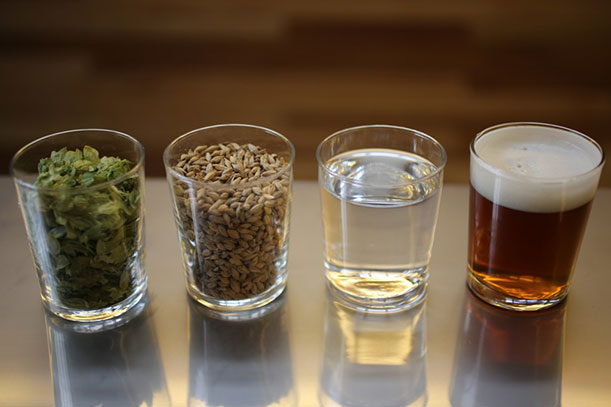
As you will experience, the malts and hops you choose will
define the taste of your beer throughout the creation process. Certain malts
will develop into sweeter flavors than others. The right combination of malts
with the hops can complement each other to give you a good, balanced brew.
Similar to many other types of pairings, the general rule applies - opposites
attract. You can also create a “hoppy” beer by choosing an especially strong
set of hops to add earthy, herbal, spicy, or even citrus-like flavors and
aromas to the beer. Hops are also what give the beer its bitter taste, which
you can later quantify in what has come to be known as International Bittering
Units (IBUs). For example, “an American Light Lager may have 5 to 8 IBUs, while
an Imperial India Pale Ale (IPA) may have 100 or more IBUs” (Nachel 1). Along
with bitterness, the color and gravity—the general viscosity or thickness of
the liquid—of the beer can largely impact the overall enjoyment of a beer.
Color begins with the grains you choose to make the beer.
“All beers have color, whether it’s light, dark, or somewhere in between…
Light-colored grains results in a pale-colored beer; conversely, darker-roaster
grains produce darker beers” (Nachel 1). Some of my favorite breweries manage
to even create red colorings in their beers. Gravity on the other hand comes
from the level of maltose dissolved in your wort. With higher levels of maltose
per unit of volume, the beer will gain a more “full-bodied” feeling. This is
similar to the idea of wine having “legs” when swirled in the glass. All of
these factors will come to define the greatness of your drinks.
Alter the Process, Define the Taste
So how do we begin the process of brewing our well-thought
creation? You will have to gather all of the required equipment and
ingredients. You will need:
-
5+ gallon boiling pot
-
A fermentor of equivalent size,
-
Sterilizer
-
Thermometer
-
Hydrometer
-
Scales (optional)
-
Straining bag (for your grains)
-
A barrel or bottles depending how you would like
to ferment your beer
-
Bottle caps and a bottle capper (if you choose
to use bottles)
-
A syphon tube
-
The ingredients of your chosen beer
Since I don’t want to bore you with all the specifics and
many steps that are subject to change with each brew, I will include a link to a
YouTube video created by WNCBikeRider that can describe the basic process with
some visual demonstrations. The man may seem a bit dry in his tutorial, but the
dryness only added to the humor in my opinion.
After a few trials, you may begin to embrace your inner
artistic self by changing your temperatures, heating times, or the volumes of
ingredients to enhance your brew to better fit your liking; I personally like
to add in multiple varieties of hops and in greater quantities to produce
exotic flavors that transform the brew into a novel creation. I have used
Simcoe hops, for example, which provide a pleasant pine flavor that I highly
recommend trying. Adding extra hops can turn your IPA into a Double IPA or even
an Imperial IPA. The endless possibilities of manipulating your beer allow you
to explore your creative side in the art of brewing.
 |
| "Image courtesy of BigCommerce.com" |
John Palmer summarizes the process in 5 easy steps:
“1. Malted barley is soaked in hot water to release the malt
sugars.
2. The malt sugar solution is boiled with Hops for
seasoning.
3. The solution is cooled and yeast is added to begin
fermentation.
4. The yeast ferments the sugars, releasing the CO2
and ethyl alcohol.
5. When the main fermentation is complete, the beer is
bottled with a little bit of added sugar to provide the carbonation,” (Palmer).
Palmer has links on his page that will describe a few
alternative methods like brewing with extract and steeped grain, but this guide
is meant to explain the more creative aspects behind the process. You begin
with a large (preferably 5 or more gallons) pot of boiling water in which you
place the grains contained in a bag, similar to a tea bag diffusing in water. When
the water is at a boil and the grains have seeped into the water, you should
add the packets of malt that you have selected. At particular intervals after
pouring in and stirring the malt, additions of hops must be added to the
mixture. The choices you have made at the start of the brewing process come in
to play here and will express their colors in the final product. In addition, the
timing of adding the yeast to the mixture can make an enormous difference in
your beer. I also told a small white lie when I said you need to decide at the
start whether the brew should be an ale or lager. It is in fact the type of
yeast you use that actually determines the category of your beer. While top-fermenting
yeast will float on the surface of your beer during fermentation and produce an
ale, bottom-fermenting yeast, in which “the yeasts sink to the bottom of the
beer during fermentation” (Nachel 2) will produce a lager. I bet you always
thought that yeast infections could only be a bad thing, but without them,
alcohol would not exist.
Unleashing Your Inner Beer Snob
Once your yeast has turned your wort to beer and you bottle
your brews, you need to continue to keep your beers in a temperature-controlled
environment. After a few weeks, your beers are ready to be tasted. If this is
your first brew then you should probably try the first opening with a sample
group to make sure the taste is at least close to par (I said the process was
fun, but not always easy). When you’re willing to share the beer on a larger
scale, I recommend having a beer tasting party. My brothers and I would invite
all of our friends whom appreciate a good beer and everyone would bring a large
bottle of a craft brew made by their favorite brewery. Give everyone a tasting
cup (preferably a clean glass each time) and a small sample from each bottle.
Now is the time to unleash your inner
beer snob.
 |
| "Image courtesy of TheCraftyBastards.com" |
To earn the title of a beer snob, you will be required to
have experience with many of the various craft brews—you can’t trust someone
who only drinks Shock Top and Coors—and a certain vocabulary to show off your
beer smarts. I mentioned earlier how you
can shoot for a well-balanced beer,
but describing a beer goes way beyond saying that one has an even level of
flavors. Beers can be hoppy or malty, floral or roasty, or perhaps even complex
and aggressive. The more you experience tasting, the better you will learn
these terms along with many more. No one becomes an expert after the first IPA.
At some point in your beer tasting party, you should bring
out your creation to allow your friends a sample. You will know immediately by
their faces if your beer should be put into a competition or poured into the
toilet. Take everything you hear into consideration and try again with your
next beer. Perhaps you added way too much malt or didn’t leave your grains in
long enough. On the other hand, you may have brewed an amazing beer. If so, you
should do your best to replicate your work and enjoy the fruits of your labor
long into retirement.
The Bottom of the Glass
Your first attempt at home brewing may be full of mistakes
and your efforts may result in a liquid so bitter that you wouldn’t let your
dog drink it. I encourage you to not let a single failure stop you. Brewing is
a fun and exciting experience when you finally get the hang of it. I highly recommend
that you brew with your best friends and drink from start to finish. One last
piece of advice I will give you is that the better your hops smell, the better
the taste they will add to your finished product. Good luck and happy brewing!
Works Cited
Ettlinger, Steve,
and Marty Nachel. “The Basic Styles of Beer”. Beer for Dummies, 2nd Edition. <http://www.dummies.com/how-to/content/the-basic-styles-of-beer.html>
Ettlinger, Steve,
and Marty Nachel. “Traits of Taste in Different Beers”. Beer for Dummies, 2nd Edition. <http://www.dummies.com/how-to/content/traits-of-taste-in-different-beers.html>
“How to home Brew
Beer in Your Kitchen”. Web. <http://drinkcraftbeer.com/home-brewing/how-to/how-to-home-brew-beer-in-your-kitchen.html>
Palmer, John.
“Introduction.” How To Brew. 2015.
Web. <howtobrew.com/book/introduction>

No comments:
Post a Comment